Gladiator Simulator: Arena War
- 4.6
- Rating
- 1.00M
- Installs
- Free
- Price
 Analysis by App-foxy
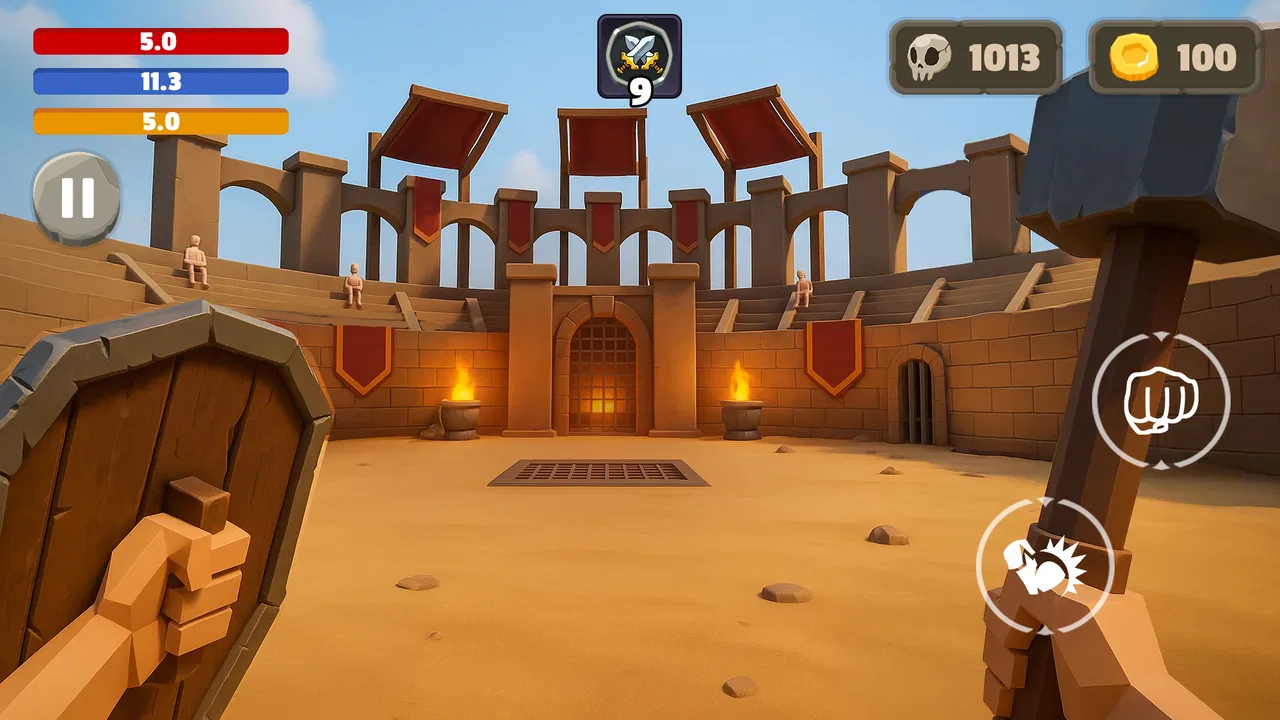
I spent time with Gladiator Simulator: Arena War as a quick-to-learn role-playing game built around gladiator fights, changing arena situations, and short bursts of combat. Its basic appeal is easy to understand: enter the arena, survive brutal encounters, and keep looking for a better run. That simple loop makes it approachable, but the roguelike structure also means that progress is not always about moving smoothly from one permanent upgrade to the next. Much of the satisfaction comes from adapting to what each attempt puts in front of you.
That distinction matters. If you want a traditional role-playing game with a long story, a large world, and carefully scripted quests, this is probably not the right place to start. If you enjoy making decisions under pressure and trying again after a failed arena run, the format is much more appealing. I found it especially suitable for short sessions, although the difficulty can make those sessions feel more demanding than relaxing.
How the arena loop feels in everyday play
The game comes from Take Top Entertainment and sits in the role-playing category, but it feels more focused than a conventional adventure RPG. The arena is the center of attention, so the experience is less about wandering through a broad setting and more about preparing for the next confrontation. The store summary describes epic gladiator games with roguelike arenas and brutal battles, and that combination gives the game its identity without needing a complicated premise.
You May Also Like

 Blood Strike: 2.5 Anniversary
Blood Strike’s Loadouts Turn Every Drop Into a Tactical Gamble
A close look at Blood Strike’s custom loadouts: how fast access to signature weapons reshapes its battle royale rhythm, rewards preparation, and narrows the gap between fights.

 Pandora - Music & Podcasts
Pandora’s Music Is Easy to Start, but Harder to Recover
Pandora’s strength is its low-effort path from a seed to a station. Its weak spot is how much confidence it asks you to place in connection, setup, and quiet recovery.

 8 Ball Pool
 Is Built on Rivalries, Rematches, and Routine
A close look at the rivalries, rematches, shared routines, and unanswered safety questions that turn a quick pool match into a persistent mobile community.

 Samsung Music
’s Quiet Strength Is Playing What You Already Own
Its reach comes less from spectacle than from dependable access to a personal library. That simplicity is both the app’s strongest retention engine and its ceiling.

 AccuWeather: Weather Radar
AccuWeather Review: A Quick, Clear Forecast for Everyday Decisions
For everyday plans, the best forecast is the one you can understand quickly. AccuWeather makes rain timing, radar, and local conditions easy to act on, with a few trade-offs.

 Hill Climb Racing
Why Hill Climb Racing Still Turns Crashes Into One More Run
A tiny car, a bumpy hill and one more upgrade: Hill Climb Racing keeps resurfacing because its simple chaos makes every near-miss feel personal.
More From Our News Desk
View All News


My first useful observation was that the early goal is not simply “win everything.” A better approach is to treat each attempt as a learning exercise. You are trying to understand how aggressively you can play, when an encounter is becoming dangerous, and which decisions keep a run alive. That makes even an unsuccessful attempt feel more useful than a random loss, provided you pay attention to what caused it.
The short description calls it a Gladiator Simulator, but I would not approach it expecting a detailed management simulation. The appeal is closer to an action-focused roguelike role-playing experience. The gladiator theme supplies the mood, while the changing arena structure supplies the replay value. I liked that the game gets to its central activity quickly instead of burying the combat under a long opening explanation.
For an everyday scenario, imagine having a short break between errands or before bed. A single attempt can give that moment a clear beginning and end: enter, make choices, fight, and see whether your run survives. The trade-off is that a bad decision near the end can make the session feel abrupt. This is not the kind of game I would choose when I want a calm, predictable activity with guaranteed progress every few minutes.
Early goals that give each attempt direction
The strongest early motivation comes from learning the rhythm of the arena. Instead of treating every opponent as a target to rush, I found it more useful to build a personal rule for each run: protect the attempt first, then look for opportunities to push forward. That mindset is important because the roguelike format makes overconfidence expensive. A player who focuses only on speed may reach a tougher encounter without enough room for mistakes.
One practical tip is to judge a run by the quality of the decisions, not only by its final result. If you lose after testing a risky approach, you have gained information about the game’s pacing. If you win while taking unnecessary chances, the victory may still teach you the wrong lesson. I recommend changing one habit at a time between attempts, such as playing more patiently or becoming more selective about when to commit to an attack.
This is also where the game separates itself from many straightforward mobile RPGs. In a more conventional title, the early objective is often to follow missions and collect enough resources for the next fixed improvement. Here, the arena itself creates the immediate question: can I handle what comes next with the choices I have made so far? That uncertainty keeps the opening from feeling like a tutorial corridor, though it may frustrate players who prefer clearly marked objectives.
Progress signals are felt more than announced
The most satisfying progress is not necessarily a large permanent milestone. It can be recognizing a dangerous situation earlier, reaching an encounter that previously stopped you, or completing a sequence with less panic. These are subtle signals, but they are meaningful in a roguelike structure because they show that your understanding is improving even when an individual run ends badly.
I would advise new players to remember why a run failed before immediately starting another one. Was the problem impatience, poor timing, or simply taking a fight that was not worth the risk? That small pause turns repetition into practice. Without it, the game can feel like a cycle of entering the arena and hoping for a better outcome. With it, the same cycle becomes a series of controlled experiments.
The game is therefore strongest for people who enjoy personal benchmarks. You may find yourself trying to survive longer, make fewer reckless choices, or handle a familiar threat with more confidence. Players who need a constant stream of visible unlocks may find this less rewarding. The experience depends heavily on whether you notice improvement in your own play rather than waiting for the game to celebrate every step.
There is also a useful distinction between progress and power. A stronger character can make a future attempt more comfortable, but understanding the arena remains valuable. If you rely entirely on advancement to solve every problem, a difficult encounter can expose that weakness later. I preferred using any improvement as support for better decisions rather than as permission to ignore danger.
The difficulty curve rewards caution, not passive play
The difficulty is most interesting when it pushes you to change your approach without making the early fights feel meaningless. Arena battles are supposed to be brutal, and the game’s tone supports that pressure. I never felt that the best response was simply to stop engaging. The better response was to become more deliberate about risk, because a roguelike run has a value that disappears when it ends.
That does not mean the curve will suit everyone. Players who enjoy fast victories and constant domination may find the later pressure tiring. The game asks for attention, and casual button pressing is less reliable once an encounter becomes threatening. On the other hand, if you like the moment when a familiar challenge becomes manageable because you have learned its pattern, the difficulty gives the arena a reason to keep your focus.
One non-obvious trade-off is that short-session design does not automatically mean low commitment. You can play for only a few minutes, but those minutes may demand the concentration of a longer game. I found it better suited to a deliberate break than to playing while distracted. If you are watching something else, commuting in a situation where attention is divided, or looking for background entertainment, the combat pressure may work against you.
I also recommend resisting the urge to restart immediately after one mistake. A damaged run can still teach you how the next encounter behaves, and finishing it may reveal whether recovery is possible. Restarting too quickly can make the game feel more random than it really is. Continuing, even when the outcome looks uncertain, gives you a clearer sense of the arena’s pacing and your own tolerance for risk.
Where retention feels natural and where it can become pressure
The replay appeal comes from the possibility that another run will unfold differently and that your improved decisions will carry you farther. That is a healthy reason to return. I enjoyed the feeling of trying again with a more specific plan rather than simply repeating the same actions. The arena format gives the game a compact identity, so it does not need a huge map to create another reason to play.
At the same time, repeated attempts can become tiring if every session turns into a demand to overcome the same wall. This is where personal preference matters. I would recommend taking a break after several failed runs instead of treating persistence as an obligation. A short pause often makes it easier to identify whether the real issue is strategy or simple fatigue.
The game is free to download and play, with optional in-app purchases ranging from $0.99 to $99.99 per item. That range is worth considering before installing. I would approach the purchase system carefully and decide in advance whether I am comfortable spending anything, especially because a challenging roguelike can make a player feel tempted to pay after a frustrating loss. The best way to judge the game is to see whether the core arena loop is enjoyable without turning every setback into a shopping decision.
For that reason, I would not recommend it to someone who dislikes free-to-play pressure in principle or who wants a completely fixed-price experience. A premium role-playing game may be a better match for that player, particularly if they prefer a campaign with predictable progression. Conversely, someone who wants a free arena game to sample in short sessions may find the entry point appealing, as long as they keep spending boundaries clear.
How it compares with familiar role-playing alternatives
Compared with story-heavy mobile RPGs, this game is more immediate and less dependent on dialogue, exploration, or a large cast of characters. Its strength is the fight itself and the tension created by the roguelike format. If you usually play games for narrative discovery, the gladiator setting may feel too narrow. If you prefer repeatable combat where your own decisions matter, the focused structure is an advantage.
Compared with simple arena games that offer one fight after another, the roguelike element gives your attempts more consequence. You are not just clearing isolated matches; you are thinking about how the current situation affects the rest of the run. That makes the game more engaging than a purely disposable battle loop, although it also means that failure can feel more personal.
It is also different from long-form character collectors. Those games often encourage you to build a broad roster and wait for scheduled improvements. Here, the central question is more immediate: can you make good choices with the run in front of you? Players who love collecting and optimizing many characters may prefer a deeper management-focused RPG. Players who want a concentrated gladiator challenge should find this more direct.
My practical comparison is simple. Choose this game when you want arena tension, compact attempts, and room to improve through repetition. Choose a traditional role-playing alternative when you want exploration, a dependable story path, or progress that feels steady even during a weak play session. Neither approach is automatically better; they serve different moods.
Who should install it, and who should skip it
I think the game is a good fit for players who enjoy roguelike decision-making, competitive arena themes, and learning through repeated attempts. It is also suitable for people who want a role-playing game that can be sampled in short sessions without committing to a huge world. The free price makes it easy to test the format before deciding whether it deserves regular space on your device.
I would be more cautious about recommending it to players who want relaxed combat, a strong narrative campaign, or guaranteed forward movement after every session. The Teen content rating is another reason parents and younger players should consider whether the gladiator violence and arena tone are appropriate for them. It is not a soft fantasy adventure; the presentation is built around brutal competition.
Device compatibility is reasonably broad, since the game requires Android 7.0 or later. The current version is 0.2.3.318, so I would keep expectations realistic about the feel of an evolving release rather than assuming the depth of a long-established RPG. Its average rating is 4.6 from around fifteen thousand ratings, and it has passed one million installs, which suggests that the compact arena concept has found a substantial audience. Those figures are useful context, but they do not replace trying the combat yourself because enjoyment depends so much on your tolerance for repetition and pressure.
My progression verdict after playing
My overall view is positive, with an important condition: the game works best when you enjoy the process of becoming better at the arena, not when you expect every attempt to deliver a large reward. Its goals are clearest in the early phase, its progress signals come from improved judgment, and its difficulty gives repeated battles a purpose. That combination can sustain play longer than the simple gladiator premise initially suggests.
The main limitation is equally clear. The same repetition that creates mastery can become a barrier if you want a smooth, generous progression path. The optional purchases also mean I would play with a budget in mind, particularly after a frustrating defeat. These are not reasons to dismiss the game, but they are important parts of the decision.
For me, the best way to approach Gladiator Simulator: Arena War is as a focused arena challenge rather than a complete replacement for a large role-playing adventure. Start free, play attentively, and give each failed run a specific lesson to carry into the next one. If that style sounds satisfying, Take Top Entertainment has built a compact game with a clear reason to return. If you want relaxed progression, extensive storytelling, or a fully predictable journey, I would choose a different RPG instead.
FAQs for Gladiator Simulator: Arena War
01What is Gladiator Simulator: Arena War?
Gladiator Simulator: Arena War is an immersive mobile game that puts players in the shoes of a gladiator fighting for glory in ancient arenas. The game features realistic combat mechanics, a variety of weapons, and a progression system that rewards skill and strategy. Players can compete against AI opponents or challenge friends in multiplayer mode.
02Is Gladiator Simulator: Arena War free to play?
Yes, Gladiator Simulator: Arena War is free to download and play. However, the game offers in-app purchases for items such as exclusive weapons, armor, and boosts that can enhance the gaming experience. While these purchases can provide advantages, they are not necessary to enjoy or progress in the game.
03What are the main features of Gladiator Simulator: Arena War?
The main features of Gladiator Simulator: Arena War include realistic combat mechanics, a variety of customizable weapons and armor, multiple arenas with unique challenges, and a progression system that allows players to upgrade their gladiator. The game also offers both single-player and multiplayer modes, providing diverse gameplay options.
04What are the system requirements for Gladiator Simulator: Arena War?
Gladiator Simulator: Arena War requires Android 5.0 or iOS 10.0 and later versions. The game performs best on devices with at least 2GB of RAM and a quad-core processor. It's recommended to have a stable internet connection, especially for multiplayer mode, to ensure a smooth gaming experience.
05Can I play Gladiator Simulator: Arena War offline?
Gladiator Simulator: Arena War offers an offline mode where players can enjoy single-player battles against AI opponents. However, features such as multiplayer battles and certain in-game events require an internet connection. Offline mode allows players to enjoy the core combat experience without network connectivity.
Pros
- Engaging combat mechanics and strategy
- Diverse range of weapons and armor
- Smooth graphics and animations
- Regular updates with new content
- Offline mode available
Cons
- Requires stable internet for multiplayer
- Some in-game ads can be intrusive
- Limited customization options
- Progression can be grind-heavy
- Occasional performance issues on older devices

Gladiator Simulator: Arena War
Gallery